
Medically reviewed by Dr. Merlin Brown, MD, Board-certified Internist | Updated November 11, 2026
BPC-157 is an experimental, laboratory-made peptide and the FDA has not approved it for any medical use. Preclinical studies suggest it may speed healing, but published human research remains limited to around 80 participants, with no trial lasting longer than two weeks. Federal rules are changing, and anti-doping authorities banned it. Consult a doctor before considering BPC-157.
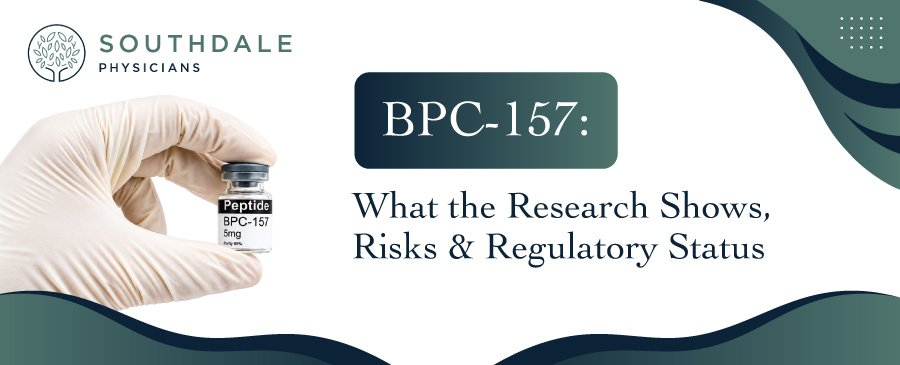
BPC-157, short for body protection compound-157, is a synthetic peptide: a short chain of fifteen amino acids, the building blocks of proteins. It was modeled on a fragment of a protein found in human stomach juice.
Online, it is often called a “healing peptide”. Preclinical research suggests it may encourage new blood vessel growth, reduce inflammation and support tissue repair. However, FDA scientists note that its exact targets in the body are unknown, so how it works is not yet confirmed.
Most people are looking for accelerated healing of tendons, joints or gut from using BPC-157. A systematic review was published in the HSS Journal in 2025 (indexed by the U.S. National Institutes of Health). Authors identified 544 records and included 36 studies. 35 were pre-clinical studies and there was only 1 clinical study. In rats there was improved healing of injured tendon, ligaments, muscle and bone. There were however no safety data available in humans and they recommend caution when using BPC-157.
The single clinical study published on PubMed was a retrospective study looking at knee pain patients who received treatment at one clinic. Of the 16 patients contacted 12 received BPC-157 alone. Of these, 11 had significant improvements. However, there was no comparison group and no formal measurement methods were used to determine improvement. Improvements like this can be due to placebo effect or just the natural progression of knee pain.
Many products will include TB-500 which is a small fragment of a natural protein called thymosin beta-4. This makes it difficult to evaluate safety of the product as you cannot tell what the reaction is due to. The table below compares BPC-157 and TB-500:
| Question | BPC-157 | TB-500 |
|---|---|---|
| What is it? | 15-amino-acid peptide | 7-amino-acid fragment |
| FDA-approved? | No | No |
| In FDA’s “Category 2” safety group | Sept. 2023 to Apr. 22, 2026 | Sept. 29, 2023 to Apr. 22, 2026 |
| FDA scientists’ advice (2026) | Recommended against listing | Recommended against listing |
| Advisory committee (July 2026) | Voted in favor | Voted in favor |
| Forms in the HHS draft policy | Injected, oral, topical | Injected only |
The pattern is clear, as the benefits are plausible but unproven. So, who might reasonably consider it?
With so little clinical evidence, no patient group has a proven reason to use it. The most reasonable candidate for a conversation is an adult with ongoing joint, muscle or digestive symptoms who has already tried standard care. Even then, a doctor should confirm the diagnosis first.
Several people should avoid it:
The reasons for these cautions appear in the risk findings below.
When it comes to finding out what BPC-157 side effects are, it is very difficult because very few people have experienced it in a controlled setting. The same FDA document noted that there were “No serious problems” in the five small studies, but stated they were short-term and safety was not monitored closely in these studies. In 28-day, preclinical studies, the FDA identified clinically relevant safety signals, such as changes in liver enzymes, and blood clotting time. A warning was also given regarding adverse reactions to local and nasal applications. Only 3 cases were identified in the FDA adverse event database up until December 2025. These included injection site reactions (redness and swelling), respiratory difficulties and darkening of skin and gums after using a formulation containing BPC-157 and TB-500. The cause was not able to be determined by the FDA.
People frequently wonder whether BPC-157 is legitimate. The answer may depend on the way it is manufactured and marketed. Since BPC-157 is not yet approved as a medication, it has to be processed through another method called compounding, which allows the pharmacy to create customized medications for individual patients as long as they use only accepted ingredients. Interestingly, in July 2026, FDA’s advisory committee voted and recommended the inclusion of BPC-157 into the 503A compounding interim access list regardless of the fact that the FDA scientists disagreed with this idea. However, since this was only an advisory vote, the issue remains unresolved.
In October 2026, the Department of Health and Human Services released a draft policy. That document mentions that the government intends to not take action against licensed pharmacies and physicians if they comply with ten conditions. These conditions include acquiring peptides from an FDA-registered manufacturer that is compliant with the current good manufacturing practices (CGMP) and having the compounding pharmacy obtain a Certificate of Analysis (COA) for each batch, using one active pharmaceutical ingredient, having a patient-specific prescription, and reporting serious adverse events and problems with product quality. Regarding BPC-157, the policy refers to the acetate form applied via subcutaneous, intramuscular, oral, and topical products. This is an interim policy, not FDA approval, meaning that it may be reconsidered upon facing safety issues or problems with product quality.
In addition, there is a stricter rule for athletes stating that U.S. Anti-Doping Agency considers this practice illegal and the medical exemption cannot be obtained.
At Southdale Physicians in Edina patients frequently ask questions about BPC-157 since they’ve read or heard about it from various sources. Because this treatment is still not approved by the FDA, this is probably not ideal in a clinical setting. Instead, we look into your medical history, examine the painful area, do the necessary tests and evaluate traditional treatment options first. Additionally, we inquire if you have ever had peptide treatment and where you got the product from since it may carry serious side effects.
Just feel free to consult with our certified medical practitioners for a review of your medical history to determine which medications are right for your health before starting the peptide treatment.
To sum things up, BPC-157 is an exciting laboratory finding, but there is no scientific proof of its effectiveness yet. Preliminary research shows certain levels of efficiency, clinical data is insufficient, and legislation is still developing regarding this matter. So, always consult with a licensed physician before taking any peptide.
Book with Allison — (952) 999-4049, same-day visits available